
Now Reading: Richard Rogers: The Humanist Architect
-
01
Richard Rogers: The Humanist Architect

Advertising

From energy-efficient appliances to eco-friendly materials, learn how to make your home greener and more sustainable.
In a world where hundreds of architects spend their time theorizing, Rogers has put his theories into practice and turned them into reality. A pioneer in the advocacy for public space, Rogers is surrounded by a legendary aura from which he cannot escape.
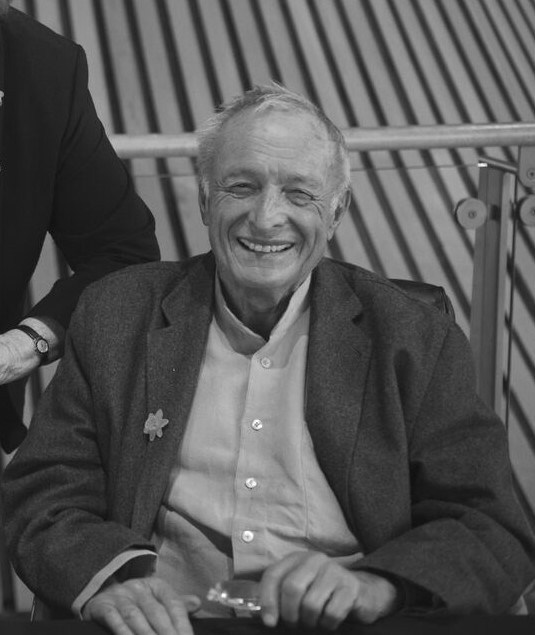
Source: Wikimedia
Richard Rogers strolls through the office of Giancarlo Mazzanti, his partner in Colombia, as if he were a god who had just created a part of the Earth. Until now, they had been nothing more than plans and vanishing points that came and went, but at this moment, after months of brainstorming in their London offices, his eyes meet that creation for the first time: the meticulous model of the Atrio Towers, two towers standing 200 and 268 meters tall, surrounded by a vast 10,000-square-meter public space in Bogotá, which will bear their signature.
He walks slowly around the model, crouches down with some difficulty, and examines it for a few seconds without saying a word. Meanwhile, a dozen architects watch him and take photos of him, as if the model were him—the perfect architect.
For many, he certainly is: he designed the iconic Centre Pompidou, revolutionized the concept of public space by creating new strategies for what he calls the “concentrated city” in London, and his mind has produced some of the most iconic and original buildings in the world today, such as Terminal 4 at Adolfo Suárez Madrid-Barajas International Airport, the Bordeaux Courthouse, the National Assembly for Wales in Cardiff, and the Millennium Dome in London. In fact, he won the Pritzker Prize in 2007, known as the Nobel Prize of Architecture.
A genius. Although none of this would be true if it weren’t for the fact that Rogers was a failure in school. The dyslexia he’s had since he was seven prevented him from studying medicine, as his parents wanted—“luckily for me.” His father was a doctor, but he didn’t diagnose the problem that prevented him from reading, memorizing, and avoiding being called stupid at school. “As a child, being dyslexic, I was always a bit of an outsider. Later, as an adult, instead of suffering because of it, I learned the value of being different.”
“I WAS ALWAYS A CHILD WHO DIDN’T FIT IN. THEN, AS AN ADULT, INSTEAD OF SUFFERING, I LEARNED THE VALUE OF BEING DIFFERENT.”
He got into architecture school through the back door, he says, and once he demonstrated his skills, he made it to Yale. More than architecture, what interested him were social and political issues. But to explore those, he felt that art, science, and mathematics were essential. Because, in reality, what Rogers longed to be was a humanist.
“I was born in Florence, and my idol was Brunelleschi. I had a sticker of him on my window. In addition to being an artist, he was a sculptor, a mathematician, an architect… and many other things. And I think that’s the role of the architect: first and foremost, he or she is a citizen. And that involves much more than simply being a decorator. Someone who, on one level, has to look at the small things—like a ruler or a pencil—and, on another level, at global issues like climate change. And that’s what excites me—what it means to me to be an architect. Do you get the idea? You have to think big, but above all, you have to play a role in a very difficult world.”
That very difficult world he refers to is market pressures, which, he says, are increasingly restricting architects’ freedom to shape society. “I often say that if we’re not careful, we’ll end up being nothing more than the window dressing of our cities. They won’t let us infuse the spaces we create—and their surroundings—with meaning.”
ARCHITECTURE SHOULD AIM TO ELIMINATE INEQUALITY.
Rogers’ theories on “Concentrated Cities”—compacted into tall buildings and densely populated—have sparked mixed reactions, but there is no doubt that his approach to architecture as a means of shaping policy and democratizing cities has been one of the most influential of our time. That is why he has always been more concerned with sustainability than with aesthetics, without neglecting the latter. He hardly wants to talk about the “high-tech” style that brought him so much fame. That phase is now behind him.
“In England, one of the most populous nations in Europe—ranked 52nd in the world—90 percent of the population lives in cities, but many of our urban centers are not sustainable. In every city, there are neglected areas, empty neighborhoods, or very poor slums that destroy the sense of community. For me, the crisis we’re facing stems from the loss of the aspiration for equality; there are striking displays of wealth and exclusivity, and many people feel they aren’t being treated fairly. We need to understand why we aren’t treating people fairly, and adapt the way we build our cities accordingly.”
How can architecture help?
“Making people happy. I’m giving you a simple answer, but deep down, that’s what it comes down to. You’re a nice person, you choose to look good, and you want your surroundings to be nice, too. It’s not that hard. The complexity comes from making space accessible to everyone; what we do is come up with ideas for that.”
In his book, *Cities for a Small Planet*, he argues that part of the solution lies in public spaces. For example, the walkways leading to the Channel 4 headquarters in London; the narrow passageway that runs the length of the Lloyd’s building and the small cemetery in front of the Tower, also in London; the narrow sidewalk around the National Assembly for Wales; and the square in front of the Courthouse in Bordeaux all demonstrate how an architect’s responsibility extends beyond the design of a single building.
For years, this socialist architect served as Tony Blair's urban planner, working alongside him to reclaim London for Londoners and get Britons out of the pubs so they could enjoy the streets.
What is the biggest challenge in achieving this?
Create adaptable buildings. Yes, I think that’s the most important thing: flexibility, indeterminacy, adaptability, and the ability for something to be inside or outside the building—these give rise to a different kind of interaction among people. The structure of buildings establishes the scale, form, and rhythm of the architectural environment, within which change and improvisation can take place. It’s like certain types of jazz, where you can improvise a melody—that’s what I compare it to. And that’s what people need.
A LORD ON A BIKE
In 1996, his full name became Lord Rogers of Riverside. Since then, at the age of 83, he has never stopped cycling to Parliament—“it gives you time to think and lets you get a feel for the places”—wearing those distinctive orange or green shirts with Mao collars, like the one he’s wearing today, which have earned him the title of “one of Britain’s best-dressed men,” according to GQ magazine. Rogers laughs when asked about that “other” title. “I love color. My mother loved it, too. I could never understand why people wear so much black—why not blue, or green…? Colors are wonderful.”
Just as with the colors he wears, Rogers has always chosen whom to work with. For him, “architecture is about relationships; it’s a team effort, and that’s essential.” That’s also why he says that although he had mentors of the caliber of Paul Rudolph, Serge Chermayeff, Vincent Scully, and Peter Smithson, his greatest lessons always came from working alongside colleagues such as Renzo Piano—with whom he worked on the Pompidou Center for six years, from 1971 to 1977—Norman Foster—with whom he founded Team 4, along with their wives at the time—and John Young, to name a few.
Now, together with his partners Graham Stirk and Ivan Harbour, he is working on several projects around the world, from Sydney to one of the towers of the new World Trade Center in New York.
Advertising






Advertising